
When you’re stepping into tile installation, whether as a beginner or a seasoned professional, the difference between a job well done and potential frustration often boils down to having the right tools. Just like a painter needs their brushes and a writer their pen, a tile installer’s toolkit is crucial for achieving efficiency and precision in their work.
The right tools can help you cut, adjust, and lay tiles in a way that’s both beautiful and functional, aligning perfectly with the expectations of homeowners who value high-quality workmanship and attention to detail. Efficiency in installation means less time grappling with inappropriate or substandard equipment, and more time perfecting those finishes that make a bathroom or kitchen shine. Precision, on the other hand, ensures every tile aligns perfectly, contributing not only to the aesthetics but to the longevity of the tiling work.
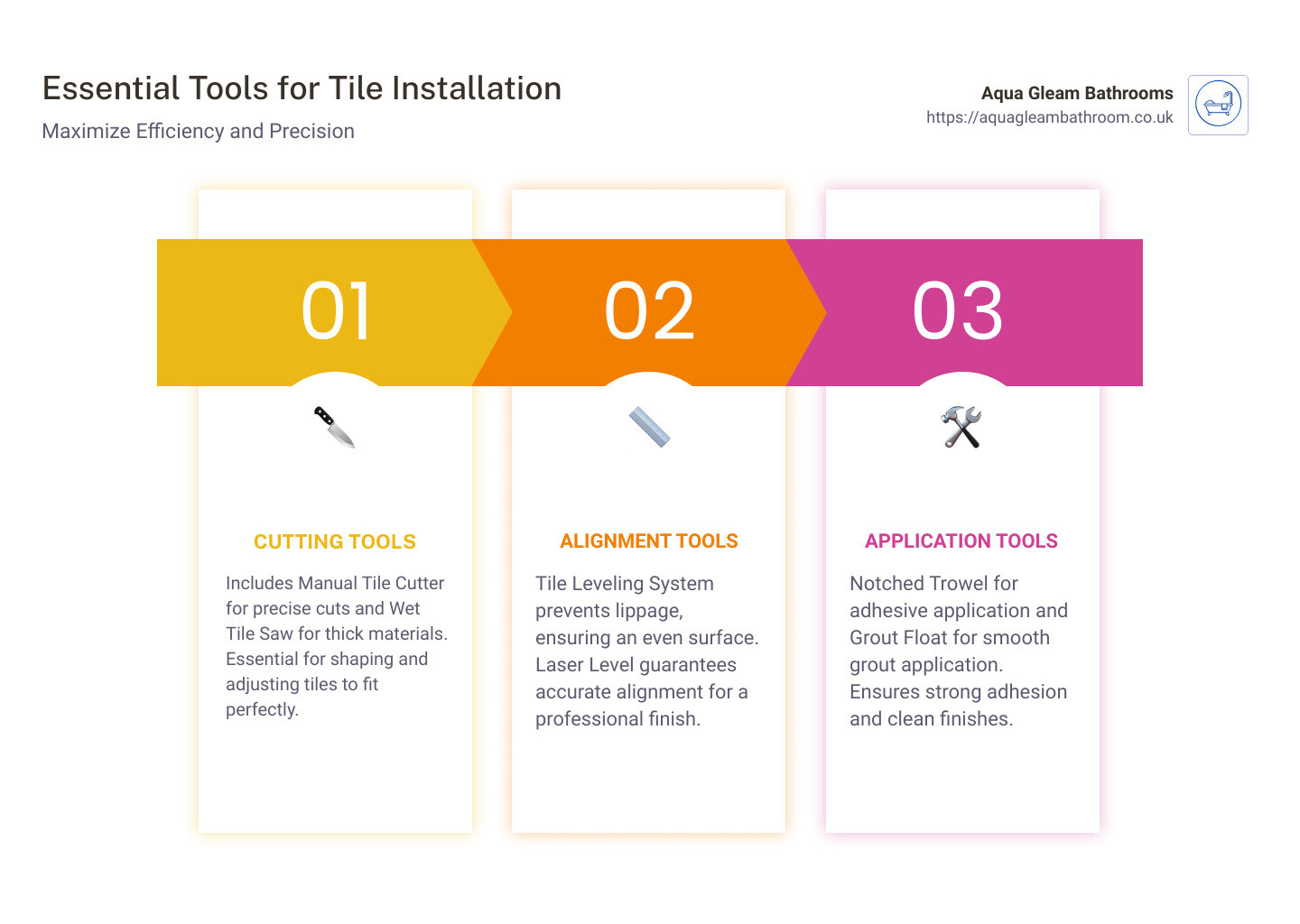
Here’s a quick overview of tools every tile installer should own:
- Manual Tile Cutter: For precise cuts and speed.
- Wet Tile Saw: Ideal for thick materials, reducing dust.
- Tile Nippers: Handy for shape customization and corner work.
- Tile Leveling System: Ensures an even surface and prevents lippage.
- Notched Trowel: Essential for adhesive application.
- Grout Float: For smooth grout application.
- Tile Spacers: Helps maintain uniform gaps between tiles.
- Knee Pads: Safety first for comfort and durability.
- Laser Level: For accurate alignment.
- Mixing Paddle: Ensures a consistent mix of materials.
These tools not only facilitate a smooth installation process but also ensure that the end result meets both the installer’s and homeowner’s expectations for a stunning, professionally finished space.
Manual Tile Cutter
When it comes to tile installation, a Manual Tile Cutter is a must-have for any tile installer looking to achieve precision, speed, and versatility in their work. This tool is pivotal for creating clean, straight cuts efficiently, making it an indispensable part of the tile installer’s toolkit.
Precision
A manual tile cutter allows for exact measurements and clean cuts with minimal effort. The built-in measuring guides help ensure each cut is precise, reducing waste and ensuring that the tiles fit perfectly in the designated space. This precision is crucial when working in areas that demand exact tile sizes, such as around fixtures or in corners.
Speed
Unlike power tools that require setup, the manual tile cutter is ready to use instantly. It’s a time-saver, allowing tile installers to make quick cuts without the need for electricity or water. This speed significantly boosts productivity, especially on large projects where time is of the essence.
Versatility
One of the greatest strengths of a manual tile cutter is its versatility. It can handle a variety of tile types, from ceramic to porcelain, making it a versatile tool for different projects. Whether it’s a kitchen backsplash or a bathroom floor, the manual tile cutter can adjust to the needs of the job.
In an article by Aqua Gleam Bathrooms, the importance of attention to detail in tile installation is highlighted, and using the right tools, like a manual tile cutter, plays a significant role in achieving that perfection . The ability to quickly and accurately cut tiles to size is a game-changer in ensuring installations are not only beautiful but functional and durable.
As we move on to explore other essential tools for tile installation, it’s clear that the manual tile cutter is a foundational tool that empowers tile installers to deliver high-quality work with efficiency and precision.
Wet Tile Saw
When tackling the complexities of cutting tile, especially for materials that are thick or dense, a Wet Tile Saw becomes an indispensable tool for any tile installer aiming for precision and efficiency. This tool stands out for its unique features that cater to the demanding nature of tile installation projects.
Water-cooled Blade for Precision Cuts: The wet tile saw uses water to cool down the blade during the cutting process. This not only prolongs the life of the blade but also enables it to cut through thick materials like porcelain, stone tiles, and dense ceramic smoothly. The water minimizes friction and heat build-up, ensuring that each cut is precise and clean.
Dust Reduction for a Cleaner Work Environment: One of the significant advantages of using a wet tile saw is its ability to reduce dust production. The water captures the tile dust generated during cutting, preventing it from becoming airborne. This not only creates a healthier work environment by reducing the inhalation of dust particles but also makes cleanup much more manageable.
Designed for Thick Materials: Thick tiles pose a challenge due to their resistance against standard cutting methods. The wet tile saw is specifically designed to handle such materials, offering the strength and stability needed to make accurate cuts without chipping or breaking the tile. This capability is crucial when working with high-quality materials, ensuring that even the most robust tiles can be shaped to fit any design.
Incorporating a wet tile saw into your toolkit as a tile installer not only enhances the quality of your installations but also contributes to a safer and cleaner working environment. It’s a testament to the importance of having the right tools for the job, enabling professionals to execute their projects with confidence and precision.
As we delve into the nuances of tile installation, it’s evident that tools like the wet tile saw are vital for overcoming the challenges posed by different materials and designs.

Moving forward, we’ll explore additional tools that continue to elevate the standard of workmanship in tile installation, emphasizing the role of precision tools in achieving a flawless finish.
Learn more about the importance of using high-quality tools in tile installation.
Tile Nippers
When it comes to the art of tile installation, not all tools are about cutting straight lines or covering large areas. Some tools, like tile nippers, shine in their ability to make the small, precise adjustments that elevate a good tile job to a great one.
Shape Customization is where tile nippers truly excel. Sometimes, you need a tile to wrap around an awkward corner or fill a tiny, irregular space. That’s when tile nippers come into their own, allowing a tile installer to carefully chip away at a tile to achieve the perfect fit.
For Small Adjustments, there’s no better tool in a tile installer’s kit. Whether it’s shaving off a sliver to ensure a snug fit or adjusting the angle of a tile edge, tile nippers provide the control needed for these delicate tasks.
Corner Work often presents a challenge during tile installations. Tiles rarely fit perfectly into every corner, especially in rooms with non-standard dimensions. Tile nippers allow installers to tailor each piece to fit snugly, ensuring a professional finish even in the most challenging spaces.
While tile nippers might seem like a simple tool compared to the more complex machinery used in tile installation, their value in achieving a polished result cannot be overstated. They allow for a level of customization and precision that complements the use of more heavy-duty tools, ensuring that every tile fits just right, regardless of the room’s quirks.
We’ll delve into other essential tools that help maintain high standards in tile installation, highlighting the importance of having the right tool for every aspect of the job.
Discover why every detail matters in tile installation, according to Aqua Gleam Bathrooms.
Tile Leveling System
Even Surface
For a tile installer, creating an even surface is not just about aesthetics; it’s about ensuring the longevity and durability of the installation. Uneven tiles can lead to a host of problems, from tripping hazards to water pooling. A tile leveling system is a game-changer in achieving that flawless, flat surface every homeowner dreams of.
Lippage Prevention
Lippage, the term used when tiles are not level with one another, can be a tile installer’s nightmare. Not only does it affect the overall look, but it also compromises the integrity of the tile work. A tile leveling system ensures each tile is set at the same height as its neighbors, preventing lippage before it starts. This is crucial in areas with high foot traffic or where water spillage is common, as it ensures safety and maintenance ease.
Professional Finish
The final look of a tiled area speaks volumes about the skill and attention to detail of the tile installer. A professional finish is not just about the tile choice but also about how perfectly aligned and level the installation is. Using a tile leveling system is like having an extra set of hands, ensuring each tile is precisely placed and maintained until the adhesive sets. This tool is indispensable for achieving that sleek, magazine-cover finish that makes clients happy and leads to referrals.
In conclusion, a tile leveling system is not just another tool; it’s an essential part of a tile installer’s kit, ensuring an even surface, preventing lippage, and guaranteeing a professional finish. By incorporating this tool into their workflow, tile installers can elevate the quality of their work, ensuring satisfaction all around.
As we gear up to explore more tools in the tile installer’s arsenal, each plays a pivotal role in transforming a space from ordinary to extraordinary.
Learn more about the importance of precision in tile installation.
Notched Trowel
When it comes to laying tiles, the Notched Trowel is an indispensable tool for every tile installer. Its primary role? Applying adhesive in just the right amount and pattern. Let’s break down why it’s a must-have in your toolkit.
Adhesive Application: The notched trowel is designed to spread tile adhesive onto surfaces with precision. Its notches help control the amount of adhesive applied, ensuring a consistent layer that’s crucial for a secure tile placement. This helps avoid problems like tiles popping off or not sticking properly.
Size Variety: Not all trowels are created equal. They come in various sizes and notch shapes to match different tile sizes and types. A larger tile might require a trowel with bigger notches to apply more adhesive, ensuring a strong bond. This variety means you always have the right tool for the job, whether you’re working with small mosaic tiles or large floor tiles.
Grip Comfort: Long hours of tile installation can be taxing on your hands and wrists. Modern notched trowels are ergonomically designed for comfort, allowing tile installers to work longer without discomfort. A comfortable grip reduces fatigue, making your tile installation process smoother and faster.
Choosing the right notched trowel is more than just picking up any tool; it’s about ensuring the adhesive is applied correctly for a durable and visually appealing finish. This tool, with its ability to spread adhesive evenly and according to the tile’s requirements, is a testament to the art and science of tile installation. It underscores the importance of using quality tools for achieving excellence in workmanship, a principle that Aqua Gleam Bathrooms emphasizes in every project.
Remember the significance of the notched trowel in achieving that perfect tile installation. Its role in adhesive application, the variety of sizes for different tiles, and the ergonomic design for comfort make it a non-negotiable tool in the tile installer’s toolkit.
Explore the meticulous attention to detail required in tile installation.
Grout Float
After discussing the notched trowel, it’s time to focus on another indispensable tool for any tile installer: the grout float. This tool is crucial for applying grout smoothly, ensuring that your tile installation looks not only professional but also beautiful.
Smooth Application: The grout float is designed to press grout into the spaces between tiles with ease, ensuring a smooth, consistent application. It’s all about getting the grout exactly where it needs to be without leaving voids or gaps.
Angled Edges: Many grout floats come with angled edges. This design feature is not just for show; it’s incredibly practical. The angled edges help in applying grout into tight spaces and corners, areas that are often challenging to reach with other tools. This ensures a comprehensive and uniform fill across the entire tile surface.
Cleanup Efficiency: One of the key benefits of using a grout float is how it simplifies the cleanup process. The float’s rubber base is designed to be just firm enough to press grout into joints but flexible enough to skim off excess material without pulling grout out of the joints. This efficiency in application means less time spent on cleanup, making the job neater and faster.
A grout float isn’t just a tool; it’s a tile installer’s partner in achieving that sleek, finished look every client desires. Its role in smoothing grout application, reaching into the nooks and crannies with angled edges, and making cleanup a breeze is why it’s a staple in the professional’s toolkit.
The right tools can make a significant difference in the quality and efficiency of your work. A grout float, with its specific design for smooth application, angled edges for precision work, and its contribution to cleanup efficiency, is a testament to this fact.
In the realm of tile installation, achieving a flawless finish is paramount, and it’s tools like the grout float that help make this possible. For more insights into the precision required in tile installations and the tools that help achieve it, explore expert tips on perfect kitchen and bathroom installations.
Transitioning from the grout float to other essential tools, let’s look at how tile spacers can further assist in achieving that perfect installation.
Tile Spacers
When it comes to laying out tiles with precision, tile spacers are indispensable. Let’s break down why every tile installer should have them in their toolkit.
-
Uniform Gaps: Tile spacers ensure that the gaps between tiles are consistent. This uniformity is key not only for the aesthetic appeal but also for the structural integrity of the tile work. Uniform gaps help in applying grout evenly, which strengthens the installation.
-
Alignment Aid: They act as a guide for aligning tiles perfectly. This is crucial in maintaining straight lines and achieving professional-looking results. Tile spacers help in avoiding the dreaded slippage or misalignment that can occur when tiles are set.
-
Various Sizes: Not all tile jobs are the same, and neither are the spaces between tiles. Tile spacers come in a range of sizes, allowing for customization according to the design requirements of the project. Whether you’re aiming for a minimalist look with thin grout lines or a more pronounced pattern with wider gaps, there’s a spacer size to match.
Using tile spacers not only aids in achieving a flawless finish but also speeds up the installation process as it reduces the need for frequent adjustments. They are a simple yet effective tool that supports both the aesthetic and functional aspects of tile installation.
For those keen on ensuring their tile work stands out for all the right reasons, incorporating tile spacers is a step in the right direction. Their role in facilitating uniformity and alignment cannot be overstated, making them a must-have for any professional tile installer.
As we delve further into the toolkit of a tile installer, the right tools can make all the difference in achieving a polished and durable finish. For additional insights and tips on tile installation, consider exploring resources provided by experts at Aqua Gleam Bathrooms (source).
Knee Pads
When you think about tile installation tools, knee pads might not be the first thing that comes to mind. But ask any professional tile installer, and they’ll tell you: knee pads are crucial. Here’s why:
Comfort
Tile installation involves spending a lot of time on your knees. Without proper protection, this can quickly become uncomfortable, making it hard to focus on the task at hand. Good knee pads provide the cushioning you need to work comfortably for longer periods.
Durability
It’s not just about comfort. The floors you’re working on can be rough and unforgiving. Durable knee pads protect your knees from scrapes and injuries. They’re made to withstand tough environments, so you don’t have to sacrifice your knees for the sake of your work.
Safety
Lastly, safety is key. Knee pads are an essential piece of personal protective equipment (PPE). They help prevent long-term damage to your knees, ensuring you can continue to work in your profession for years to come without suffering from chronic knee problems.
For tile installers, investing in a good pair of knee pads is as important as choosing the right tile cutter or wet saw. They might not be the most glamorous tool in your kit, but they play a critical role in ensuring you can do your job effectively, comfortably, and safely.
As we move on to explore other essential tools for tile installation, each piece of equipment, no matter how small, has its place in creating a successful, beautiful finish. For more detailed insights into tile installation, Aqua Gleam Bathrooms offers a wealth of knowledge and advice (source).
Laser Level
When it comes to laying tiles with precision and efficiency, a Laser Level is an indispensable tool for every expert tile installer. This device projects straight, level lines onto surfaces at any angle, ensuring that each tile is perfectly aligned. Here’s why it’s a must-have in your toolkit:
-
Accuracy: Laser levels provide pinpoint precision, which is crucial for creating visually appealing tile layouts. This tool helps ensure that your tiles are aligned correctly from the start, reducing the need for time-consuming adjustments later.
-
Time-saving: By using a laser level, tile installers can significantly speed up the setup process. It quickly provides you with a guide for laying tiles in a straight line, saving you from constantly measuring and re-measuring distances and angles.
-
Alignment: Whether you’re working on a wall or floor, a laser level helps maintain a consistent level throughout the installation. This is particularly important when installing large sections of tile, where even minor discrepancies can become glaringly obvious.
A laser level is not just a luxury but a necessity for achieving professional results. It’s about bringing efficiency and precision together, ensuring that every tile installation project is completed to the highest standard. This is a principle that Aqua Gleam Bathrooms emphasizes in their focus on attention to detail and commitment to excellence in kitchen and bathroom installations (source).
As we move on to explore other essential tools for tile installation, each piece of equipment, no matter how small, has its place in creating a successful, beautiful finish. For more detailed insights into tile installation, Aqua Gleam Bathrooms offers a wealth of knowledge and advice.
Mixing Paddle
As we delve deeper into the toolkit of a tile installer, the Mixing Paddle emerges as an indispensable ally. This tool might seem simple at first glance, but its role in ensuring a consistent mix for your tile adhesive or grout cannot be overstated.
Consistent Mix
The essence of a good tile installation lies in the foundation – and that foundation is often a well-mixed adhesive. The mixing paddle ensures that your adhesive’s consistency is uniform, eliminating any lumps that could compromise tile adhesion and longevity. A smooth, consistent mix translates to a smoother application process and a stronger bond.
Power Drill Attachment
One of the most significant advantages of a mixing paddle is its compatibility with a standard power drill. This feature transforms a manual, labor-intensive task into an efficient, mechanized process. By attaching the mixing paddle to your drill, you can mix large quantities of adhesive or grout quickly, saving both time and energy. This efficiency is crucial, especially in larger tiling projects where time is of the essence.
Easy Cleanup
After a long day of tile installation, the last thing any tile installer wants is a challenging cleanup. Thankfully, modern mixing paddles are designed with easy cleanup in mind. Most models are made from materials that allow adhesive or grout to be easily scraped off once it dries. Additionally, many paddles are dishwasher safe, making the cleanup process even simpler.
A mixing paddle is more than just a tool; it’s a facilitator of quality and efficiency in tile installation. Its ability to ensure a consistent mix, coupled with the convenience of being a power drill attachment and the ease of cleanup, makes it an essential tool in the arsenal of any serious tile installer. For those looking to dive into the intricacies of tile installation and gather more expert advice, Aqua Gleam Bathrooms is an excellent resource .
As we move on to explore other essential tools for tile installation, each piece of equipment, no matter how small, has its place in creating a successful, beautiful finish. For more detailed insights into tile installation, Aqua Gleam Bathrooms offers a wealth of knowledge and advice.
Frequently Asked Questions about Tile Installation
What’s the best way to cut tile for intricate designs?
Cutting tile for intricate designs requires precision and the right tool. A wet tile saw is ideal for making precise cuts and can handle complex patterns. It uses water to cool the blade, reducing dust and preventing the tile from overheating. For really detailed work, a manual tile cutter might not offer the flexibility needed. Practice makes perfect. Before cutting your actual tiles, try your designs on some waste pieces to perfect your technique.
How do I prevent lippage when installing tile?
Lippage, the variation in height between edges of adjacent tiles, can ruin the look of a tiled surface. To prevent it, using a tile leveling system is key. This system helps by keeping tiles at the same height during installation until the adhesive sets. Start by selecting the right size of leveling spacers for your tile thickness, and ensure your substrate is as level as possible before starting. Consistency in your adhesive application using a notched trowel also helps in reducing lippage.
Can I use the same tools for ceramic and porcelain tiles?
Yes, you can use the same tools for both ceramic and porcelain tiles, but with caution. Both materials can be cut and installed using a wet tile saw, manual tile cutter, and tile nippers. However, porcelain tiles are denser and harder than ceramic tiles, which means they may require a diamond blade when cutting with a wet saw for a smoother finish. Always ensure your tools are in good condition to handle the hardness of porcelain tiles.
For more insights on choosing the right materials and ensuring a professional finish in your tile installation projects, Aqua Gleam Bathrooms provides comprehensive guidance and expert advice .
Understanding the importance of using the right tools and techniques cannot be overstated. Every tile installer knows that the beauty of the finished project lies not just in the tiles chosen but in the precision and care of the installation.
Conclusion
In the meticulous world of tile installation, attention to detail is not just a requirement; it’s the cornerstone of excellence. At Aqua Gleam Bathrooms, we understand that the difference between a good job and a great one lies in the minutiae—the precise cut of a tile, the flawless alignment, and the seamless grout lines that bring a design to life. Our commitment to detail ensures that every project we undertake reflects our high standards and your personal vision.
Our ethos is simple: we believe in doing things right. This belief extends to the tools we use, the techniques we employ, and the continuous learning we engage in to stay at the forefront of our industry. The world of tile installation is changing, with new materials, tools, and technologies constantly emerging. As such, we make it a priority to keep our skills sharp and our knowledge up-to-date. This commitment to continuous improvement allows us to tackle any project, no matter how complex, with confidence and expertise.
Choosing Aqua Gleam Bathrooms means partnering with a team that values precision, aesthetics, and functionality in equal measure. We take pride in our work, knowing that it’s not just about installing tiles—it’s about creating spaces that you love. Whether you’re renovating your kitchen, bathroom, or any other area of your home, you can trust us to bring your vision to life with an unmatched level of care and professionalism.
The beauty of a tiled space is in its details. And at Aqua Gleam Bathrooms, we’re all about the details. By embracing continuous learning and staying dedicated to our craft, we ensure that every installation is not just done but done perfectly.
In conclusion, whether you’re a professional tile installer looking to refine your craft or a homeowner dreaming of a beautifully tiled space, the key to success lies in attention to detail, the right tools, and a commitment to continuous learning. And if you’re looking for a partner to help bring your vision to life, look no further than Aqua Gleam Bathrooms.